
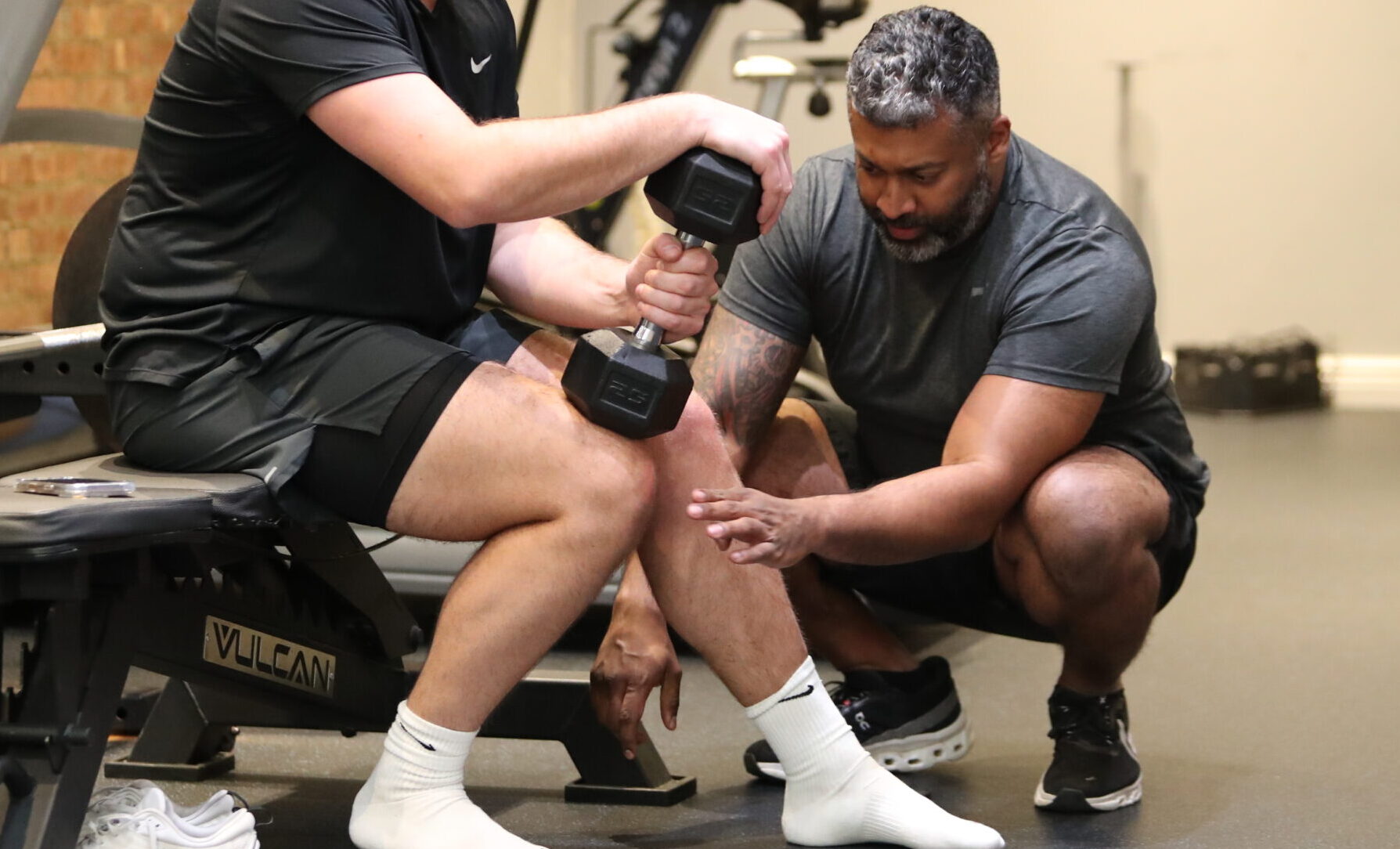
What we treat
Move without Knee pain
Knee Pain Physical Therapy in Midtown Manhattan
Get back to running, lifting, stairs and sport with a plan that fixes the cause, not just the pain.
A lot of knee pain isn’t really a knee problem. It comes from how the whole leg moves and handles load: stiff hips, weak quads or glutes, an old ankle sprain, or doing too much too soon.
Rest and painkillers can quiet it down for a while. But the pain tends to come back as soon as you return to what you love.
At Recalibrate Physical Therapy, Dr. Steve Sunderraj, DPT, finds what’s driving your knee pain. Then he rebuilds the strength your knee needs, so you can stop working around it.
What we treat
Knee problems we treat
Whether your knee aches on the stairs, swells after a run or hasn’t felt right since surgery, we find the cause and build a plan around it.
-
Runner’s knee
Patellofemoral painAching around or behind the kneecap, often worse on stairs, squats or after sitting.
-
Jumper’s knee
Patellar tendinopathyPain just below the kneecap when you jump, run or squat.
-
Ligament injuries
MCL, LCL and ACLSprains and tears, whether or not you’ve had surgery.
-
Meniscus tears
Cartilage injuriesClicking, catching, locking or swelling after a twist.
-
IT band pain
Outer knee painPain on the outside of the knee, common in runners and cyclists.
-
Knee arthritis
OsteoarthritisStiffness and aching that make walking, stairs or getting out of a chair hard.
-
After knee surgery
Post-operative rehabACL reconstruction, meniscus repair and knee replacement.
-
Unexplained knee pain
No clear causeAching or stiffness that just won’t go away.
Alesya Y., Google reviewI had a partially torn MCL and within only a few sessions he had the knee strengthened and functional.
The Recalibration Method
How we treat knee pain: strength first
We rebuild your knee in stages. You move to the next stage only once you’ve mastered the current one, so you don’t flare up from doing too much too soon.
-
Evaluate
We test how your hips, knees and ankles move and how strong each leg is, to find the cause and check whether you need imaging or a specialist.
-
Restore motion
We clear the stiffness in your hip, knee and ankle that forces your knee to compensate.
-
Build strength
Targeted exercises like hamstring curls, calf raises and lunges fix the imbalances between your legs.
-
Load the squat
Once your knee is stable, we add squats and build toward bodyweight and beyond.
-
Add power
Jumping and hopping prepare your tendons and joints for impact.
-
Return to sport
When it’s pain-free, you start interval running, then build to continuous running, sprinting and your sport.
Your plan, your goal Your plan stops where your goal is. For some people that’s climbing subway stairs without pain; for others it’s finishing a marathon or getting back under a barbell.
Your visits
What to expect
From your first call to your last session, you’ll always know what’s next and why.
-
Book it free
A free phone consultation
Tell us about your knee, and we’ll tell you honestly whether physical therapy is the right next step.
-
A thorough first visit
An in-person evaluation of your history, movement and strength, then a clear explanation of what’s going on and your plan.
-
Personal attention
You work with Dr. Steve in a small, private gym near Herald Square, not a crowded clinic.
-
A plan you understand
You learn why each exercise matters and how to progress it yourself, so you stay strong after therapy ends.
Insurance & Cost
Out-of-network, without the guesswork
Recalibrate is an out-of-network practice. We accept all insurance plans with out-of-network benefits, as well as no-fault insurance. We check your coverage before your first visit, so there are no surprises.
-
Send your card
Upload a photo of the front and back of your insurance card.
-
We check your benefits
We verify your out-of-network coverage before you come in.
-
Start with clarity
You know what to expect before your first session.
- Out-of-network insurance Any plan with out-of-network benefits
- No-fault insurance For injuries from a car accident
- $500 Four-week rehab program, flat rate, no weekly visits needed
Knee Pain FAQ
Your knee questions, answered
Straight answers about knee pain and physical therapy. Have a question that isn’t here? Ask Dr. Steve during a free consultation.
Book a free consultationDo I need a doctor’s referral to start physical therapy in New York?
No. New York lets you see an experienced physical therapist without a referral for up to 10 visits or 30 days, whichever comes first. After that, you’ll need a referral to continue. Some insurance plans only cover visits with a referral, so check your plan or ask us to verify it.
How long does physical therapy for knee pain take?
It depends on the problem and your goals. Many people feel a difference within a few weeks. Tendon problems usually take a few months, and returning to sport after ACL surgery typically takes nine months or more. After your evaluation, we’ll give you a realistic timeline.
Should I rest my knee or keep exercising?
Complete rest rarely fixes knee pain, and it lets the muscles that protect your knee get weaker. Usually the answer is to change what you’re doing, not stop. We’ll show you what you can keep doing safely while we rebuild.
Can physical therapy help me avoid knee surgery?
Often, yes. Many knee problems, including many meniscus tears and knee arthritis, are treated with exercise-based therapy before surgery is considered. Some injuries do need a surgeon, and if yours does, we’ll tell you and help you find the right one.
Do you take my insurance?
We’re an out-of-network practice. We accept all insurance plans with out-of-network benefits, plus no-fault insurance, and we can verify your benefits before your first visit.
Where are you located?
11 West 36th Street, 4th Floor, New York, NY 10018, between Fifth and Sixth Avenues. We’re a short walk from Herald Square (B, D, F, M, N, Q, R and W trains), Penn Station and Grand Central.